Nearly One-Third of the World Can't Reliably Call

Internet-based voice and video calling is often assumed to be a basic layer of digital infrastructure. Yet current estimates indicate that approximately 29 percent of the global population—nearly 2.3 billion people—lives in countries where internet calling (VoIP) is restricted, censored, throttled, or banned in some form.
For leaders building global technology platforms or shaping digital policy, this is not a marginal edge case. It represents a structural constraint affecting billions of users, with consequences for regulation, product design, analytics, and global scalability.
What "VoIP Restrictions" Actually Look Like
Restrictions on internet-based calling are not uniform. They fall into distinct categories, each with different operational and user impacts.
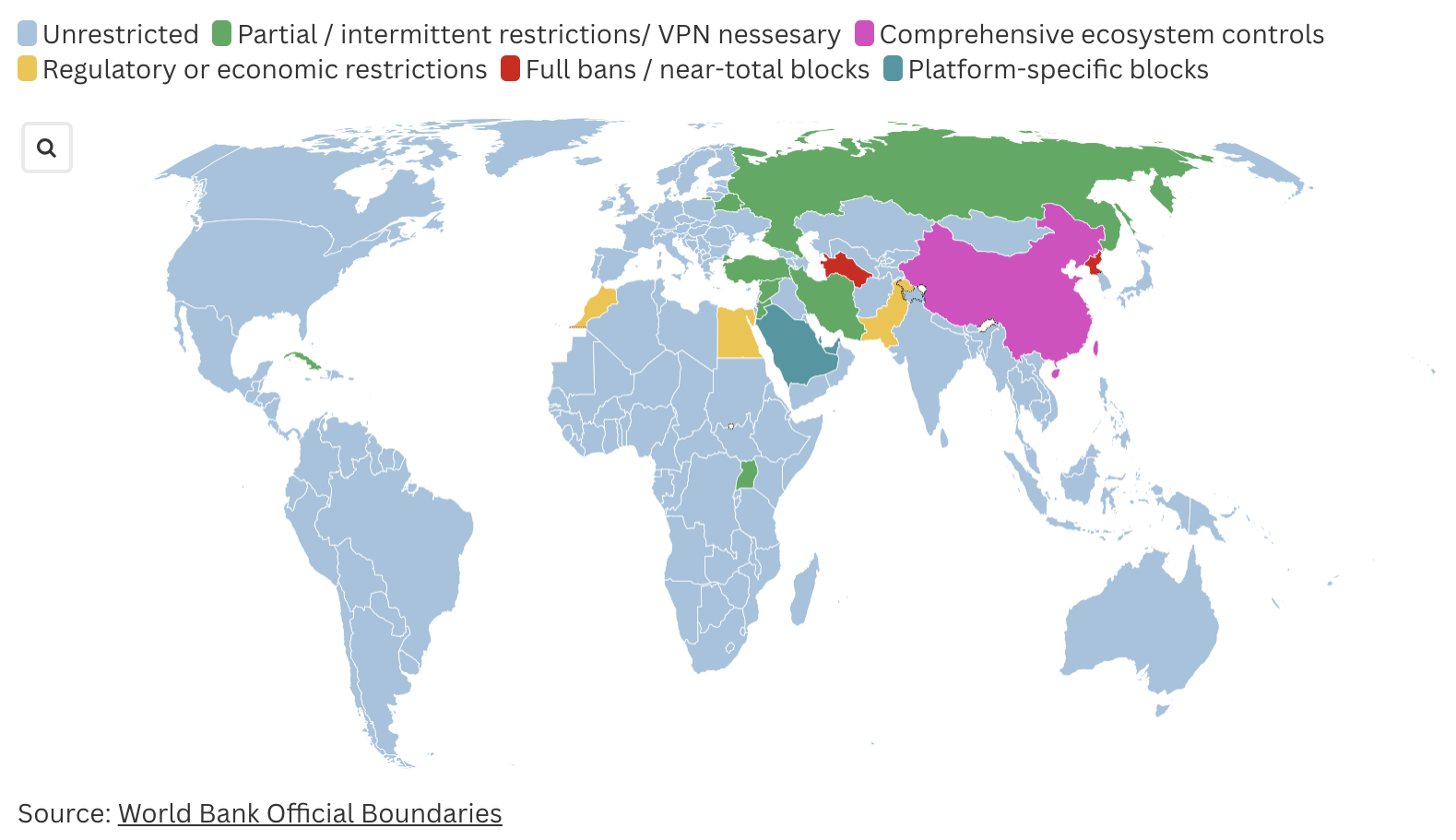
VoIP Restriction Types and Population Exposure
| Restriction Type | Description | Example Countries | Est. Population |
|---|---|---|---|
| Full bans / near-total blocks | International or app-based calling largely inaccessible | North Korea, Turkmenistan | ~34M |
| Platform-specific blocks | Certain apps (e.g., WhatsApp, FaceTime) blocked; alternatives allowed | UAE, Saudi Arabia, Qatar | ~40M |
| Regulatory or economic restrictions | VoIP allowed only via licensed providers; others throttled or degraded | Egypt, Pakistan, Morocco | ~412M |
| Partial / intermittent restrictions | Temporary shutdowns, throttling, or selective blocking; VPN necessary | Iran, Russia, Belarus, Turkey, Cuba, Syria, Jordan, Uganda | ~432M |
| Comprehensive ecosystem controls | Broad censorship and platform blocking | China | ~1.4B |
Total population exposed: ≈ 2.3 billion (29% of world's population)
Excluding China: ≈ 0.9 billion (11% of world's population)
The Reality of Partial Restrictions
Most affected users are not under full communication blackouts. Instead, they experience unreliable, inconsistent, or constrained calling conditions:
- Calls that fail intermittently
- Services that work only on certain networks
- Quality that degrades during peak or sensitive periods
- Access limited to approved platforms only
From a product and analytics perspective, these partial restrictions often matter as much as outright bans because they create silent failure modes: user intent exists, but successful completion does not.
The Data Problem
This has downstream consequences for how digital access is measured and interpreted:
- Failed or degraded calls are recorded as user drop-off or disengagement
- Structural constraints are misdiagnosed as poor product-market fit
- Engagement metrics, retention analysis, and geographic comparisons become distorted
- Feature prioritization is skewed by incomplete data
When access is unreliable, both user experience and data fidelity suffer—widening the gap between observed behavior and actual user needs.
Why These Restrictions Persist
Despite rapid digitization, VoIP restrictions have not declined. The reason is straightforward: internet calling reduces centralized control over communication and makes censorship more difficult.
Across countries, three incentives consistently reinforce restrictions:
1. Control and Oversight
Internet-based calls, especially encrypted ones, reduce governments' ability to monitor and regulate communication, limiting centralized oversight.
2. Telecom Revenue Protection
Free or low-cost VoIP undermines traditional voice revenues, which are often tied to state-owned or heavily regulated operators.
3. Political Risk Management
During elections, protests, or crises, real-time communication is viewed as a coordination risk and is often restricted to manage political or social outcomes.
Digitization has not eliminated these incentives—it has amplified them. As a result, restrictions remain common rather than fading with technological progress.
Policy and Market Implications
| Stakeholder | Impact |
|---|---|
| Governments | Trade-offs between control, competitiveness, and digital inclusion |
| Global tech platforms | Fragmented feature availability, increased compliance complexity, legal obstacles, and limited global reach |
| Enterprises & remote teams | Uneven collaboration capabilities across regions and constraints on hiring talent from countries with enforced censorship |
| Consumers | Higher friction, higher costs, limited choice, and restricted communication between families and friends |
| Developers & startups | Increased localization, regulatory overhead, and potential technological regression |
For policymakers, restrictions shape a country's attractiveness for global digital services, tech investments, and talent acquisition. For companies, these restrictions turn "global" products into region-specific implementations, driving up costs, increasing compliance overhead, and redirecting engineering capacity away from product innovation.
Conclusion
The fact that approximately 29 percent of the global population—nearly 2.3 billion people—lives in countries where internet-based calling is restricted, censored, or unreliable fundamentally reframes how we should think about digital communication. Internet calling is not a universal utility. It is a privileged capability, unevenly distributed and shaped as much by policy as by technology.
These restrictions are not a transitional phase of underdevelopment, nor a lag in infrastructure modernization. They result from deliberate policy choices designed to:
- Preserve centralized control over communication
- Protect legacy telecom revenue models
- Manage governance and security risks
As digital economies expand and encrypted real-time communication becomes more powerful, these incentives persist—and in many cases intensify—rather than fade.
For Technology Leaders
This reality has direct and measurable consequences:
- Products built on the assumption of unrestricted connectivity encounter silent failure modes across large portions of the global market
- User intent remains high, but conversion, retention, and feature adoption metrics systematically underrepresent demand
- Without explicitly accounting for regulatory and policy constraints, analytics misdiagnose friction as disinterest
Building Truly Global Products
Building truly global products requires more than technical scalability. It requires:
- Regulatory awareness
- Regionally adaptive design
- Metrics that distinguish user choice from structural constraint
Until these factors are treated as first-class considerations, global connectivity will remain uneven by design.
In an increasingly connected world, the absence of a call is often not the absence of demand. It is the absence of permission.
This is why Spritz is built on Logos Messaging—a decentralized, peer-to-peer communication protocol that doesn't rely on centralized servers that can be blocked. Combined with proof of personhood for human verification, we're building communication infrastructure that works for everyone, everywhere.